Commercial tree work has to fit the property and its daily operations
Commercial tree service is less about one homeowner's backyard and more about managing trees around people, vehicles, tenants, customers, signage, parking, loading areas, sidewalks, lighting, and operations. A property manager may need deadwood removed over parking, clearance around buildings, removal of a failed tree, storm cleanup across several buildings, or phased pruning throughout a community. The estimate should reflect the operational constraints as well as the tree work.
South Fulton includes major commercial and transportation corridors along with apartments, churches, offices, industrial uses, and neighborhood retail. On those sites, timing and site control can matter as much as equipment. Work may need to avoid school arrival, worship services, loading windows, peak retail traffic, trash collection, or resident parking. Sharing those restrictions during the estimate allows a contractor to plan labor and equipment more accurately.
How commercial tree work is coordinated
For multi-tree properties, a prioritized work can be more useful than a long undifferentiated list. Immediate hazards can be separated from maintenance pruning, removals, stump work, and longer-term monitoring. That helps owners and managers allocate budgets while addressing the highest-consequence problems first. It also creates a record that can be revisited as conditions change.
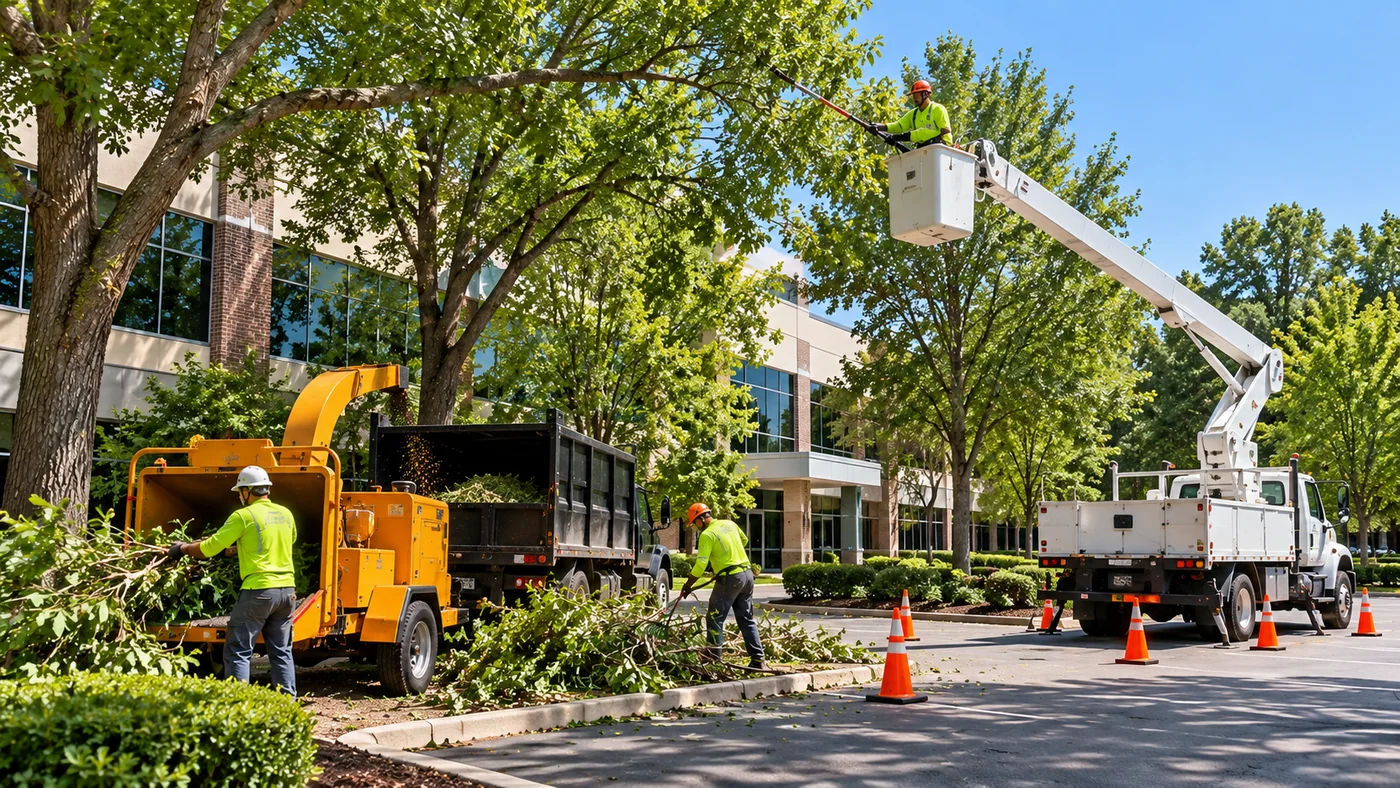
Access planning may involve cones, temporary parking closures, spotters, pedestrian routing, loading-zone coordination, or communication with tenants. The contractor should understand whether the property can accommodate a chip truck, aerial lift, loader, or crane and where debris can be staged. If the property has underground utilities, irrigation, lighting, or sensitive pavement, those constraints should be identified before work starts.
South Fulton site conditions that can affect commercial work
Commercial sites can create root stress that is less obvious than storm damage. Compacted parking-edge soils, grade changes, trenching, heat reflected from pavement, restricted rooting area, and repeated construction can contribute to decline. UGA's guidance on construction damage is relevant because roots in Georgia clay are often relatively shallow and can be affected by equipment or soil changes far from the trunk.
For developed sites, local permitting and tree-preservation requirements can also be more relevant than they are for routine work at an individual home. South Fulton's tree ordinance is specifically tied to development, building construction, and timber-harvest activity. Managers planning redevelopment, expansion, or land disturbance should verify the current city requirements before treating tree removal as an isolated maintenance task.
What affects commercial tree service cost
Commercial tree work is usually scoped from the site, tree inventory, access, traffic exposure, disposal, scheduling, and required documentation rather than a single per-tree number. These figures are broad market planning guidance, not a quote or a fixed company rate. See the full South Fulton tree service cost guide for more context. The actual estimate depends on the tree, property, access, equipment, cleanup, and the exact work requested.
- Number of trees and work zones
- Traffic, tenant, and pedestrian control
- Equipment staging and parking restrictions
- After-hours or phased scheduling
- Debris volume and disposal logistics
- Documentation or property-management coordination
- Development or permitting context
Two projects with similar-looking trees can price very differently when one has open truck access and the other sits behind a house with a narrow gate, fence, overhead utilities, soft ground, or a roof beneath the canopy. When comparing estimates, focus on whether each proposal includes the same work: debris hauling, stump work, rigging, restoration, traffic control, and any return visit should be clear rather than assumed.
Keep the property operating while work is underway
A commercial proposal is easier to execute when the owner or manager identifies operational constraints before the crew is scheduled. Note delivery windows, tenant parking, emergency lanes, school or daycare activity, worship services, loading docks, trash pickup, security procedures, and areas that cannot be blocked. This information may influence which part of the property is addressed first or what equipment can be staged. It can also prevent a routine tree job from becoming a property-management headache because the work zone conflicts with the busiest part of the business day.
Tree inventories and recurring priorities
Properties with many trees benefit from consistent naming and prioritization. A basic inventory can identify a location, approximate species or tree type, visible concern, recommended action, and priority. It does not need to become an elaborate software project to be useful. The goal is continuity, especially when budgets require work to be phased. A manager can address immediate hazards, then clearance needs, then routine pruning and monitoring. Future inspections become easier because the team can compare the same trees over time instead of starting from a blank sheet after every storm or management change.
What to include when requesting a commercial estimate
You do not need technical tree vocabulary. Tell us what you see and what you want the property to be like when the work is finished. Useful details include the number of trees or stumps, approximate size, whether branches or the trunk have already failed, what is nearby, whether trucks can reach the work area, and whether the concern feels urgent. The city and ZIP code help confirm travel and service coverage. If the condition involves a recent storm, construction work, new leaning, mushrooms, unusual leaf change, or repeated limb drop, mention that history too.
Photos from a safe location can be useful for context, but the final work may still need an on-site look. Do not climb, walk under hanging limbs, or approach electrical lines to take pictures. The goal is to give the contractor enough context to plan the next step without asking you to diagnose or measure a hazardous tree yourself.