When cabling or bracing may be worth considering
Cabling and bracing are not generic upgrades for every large tree. They are supplemental support systems used in selected situations where a tree has a structural feature that may benefit from added support. Common examples include co-dominant stems with a weak union, a heavy lateral limb, or a mature tree with a defect where removal is not automatically the preferred outcome. The decision has to start with inspection because hardware cannot correct every structural problem.
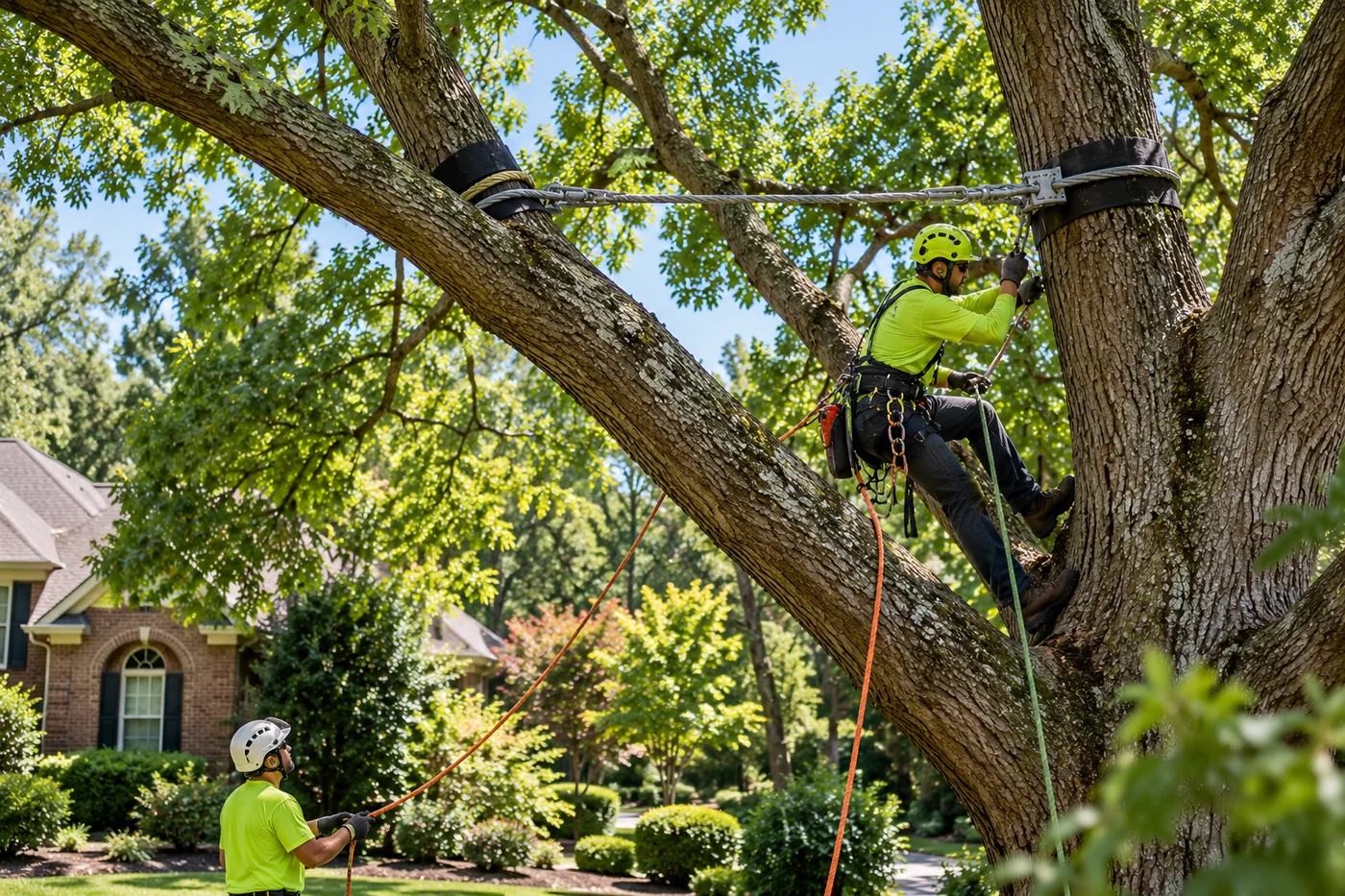
A cable generally works higher in the crown to limit movement between stems or limbs, while bracing rods may be used lower in a union to provide more rigid support. The exact configuration depends on anatomy, load, defect location, and installation standards. Property owners should be wary of treating a visible split or included-bark union as a simple 'put a cable in it' project. Some trees need pruning in combination with support, some need monitoring, and some are poor candidates for retention.
How cabling and bracing is evaluated
Support-system planning considers the condition of the wood where hardware would be installed, the geometry of the stems, the target below the tree, and the consequences of failure. A contractor may recommend load-reduction pruning before or with cabling so the system is not expected to carry avoidable weight. In other cases, the tree's decay or root condition may make support inappropriate.
Cabling also creates a maintenance responsibility. Trees continue to grow, stems move, and hardware ages. A support system should not disappear from the owner's mind after installation. Periodic inspection is important to confirm the hardware remains appropriately positioned and that the tree has not developed new defects. Any proposal should make clear what system is being recommended and what follow-up the owner should expect.
South Fulton conditions that matter when supporting mature trees
South Fulton has many mature shade trees growing near homes, streets, churches, and larger lots. Mature crowns can develop substantial lateral weight, and thunderstorms add dynamic loading. Cabling may be worth discussing when a valued tree has a specific weak union but otherwise has enough sound structure to justify retention.
The local climate also means trees can put on vigorous growth during long growing seasons. More foliage and longer branches can change loading over time, especially after selective clearing exposes a formerly sheltered tree to more wind. If nearby trees were recently removed or construction opened the property, or a large limb has already failed, mention that history during the assessment.
What affects cabling and bracing cost
Cabling and bracing is inspection-driven. Price depends on tree size, number and type of supports, climbing access, hardware placement, and follow-up needs. These figures are broad market planning guidance, not a quote or a fixed company rate. See the full South Fulton tree service cost guide for more context. The actual estimate depends on the tree, property, access, equipment, cleanup, and the exact work requested.
- Tree height and climbing difficulty
- Number of stems or limbs being supported
- Cable, brace, or combined system
- Amount of companion pruning
- Hardware installation points and wood condition
- Access for lift or climbing systems
- Inspection and maintenance expectations
Two projects with similar-looking trees can price very differently when one has open truck access and the other sits behind a house with a narrow gate, fence, overhead utilities, soft ground, or a roof beneath the canopy. When comparing estimates, focus on whether each proposal includes the same work: debris hauling, stump work, rigging, restoration, traffic control, and any return visit should be clear rather than assumed.
Cabling does not make every weak tree safe
A cable can reduce relative movement between stems, but it does not repair decayed wood, restore severed roots, or guarantee that a tree will not fail elsewhere. Bracing can reinforce a union, but it also requires suitable wood and correct placement. That is why hardware should be treated as one tool in a broader assessment. The contractor should be able to explain the defect being addressed, why support is reasonable, whether pruning is part of the plan, and what conditions would make removal a better choice. If the recommendation is simply 'add a cable because the tree is big,' the reasoning is incomplete.
Support systems need periodic inspection
Supplemental support systems live in a growing organism. Branch diameter changes, attachment points move relative to the crown, storms alter loading, and new defects can appear. A property owner should keep records of what was installed and arrange periodic inspection rather than assuming the system is permanent and maintenance-free. Dynamic and static systems also behave differently, so the follow-up interval and inspection points should match the hardware used. If ownership changes, passing along that information helps the next owner understand why hardware is present and what it was intended to accomplish.
What to tell us about the tree
You do not need technical tree vocabulary. Tell us what you see and what you want the property to be like when the work is finished. Useful details include the number of trees or stumps, approximate size, whether branches or the trunk have already failed, what is nearby, whether trucks can reach the work area, and whether the concern feels urgent. The city and ZIP code help confirm travel and service coverage. If the condition involves a recent storm, construction work, new leaning, mushrooms, unusual leaf change, or repeated limb drop, mention that history too.
Photos from a safe location can be useful for context, but the final work may still need an on-site look. Do not climb, walk under hanging limbs, or approach electrical lines to take pictures. The goal is to give the contractor enough context to plan the next step without asking you to diagnose or measure a hazardous tree yourself.