


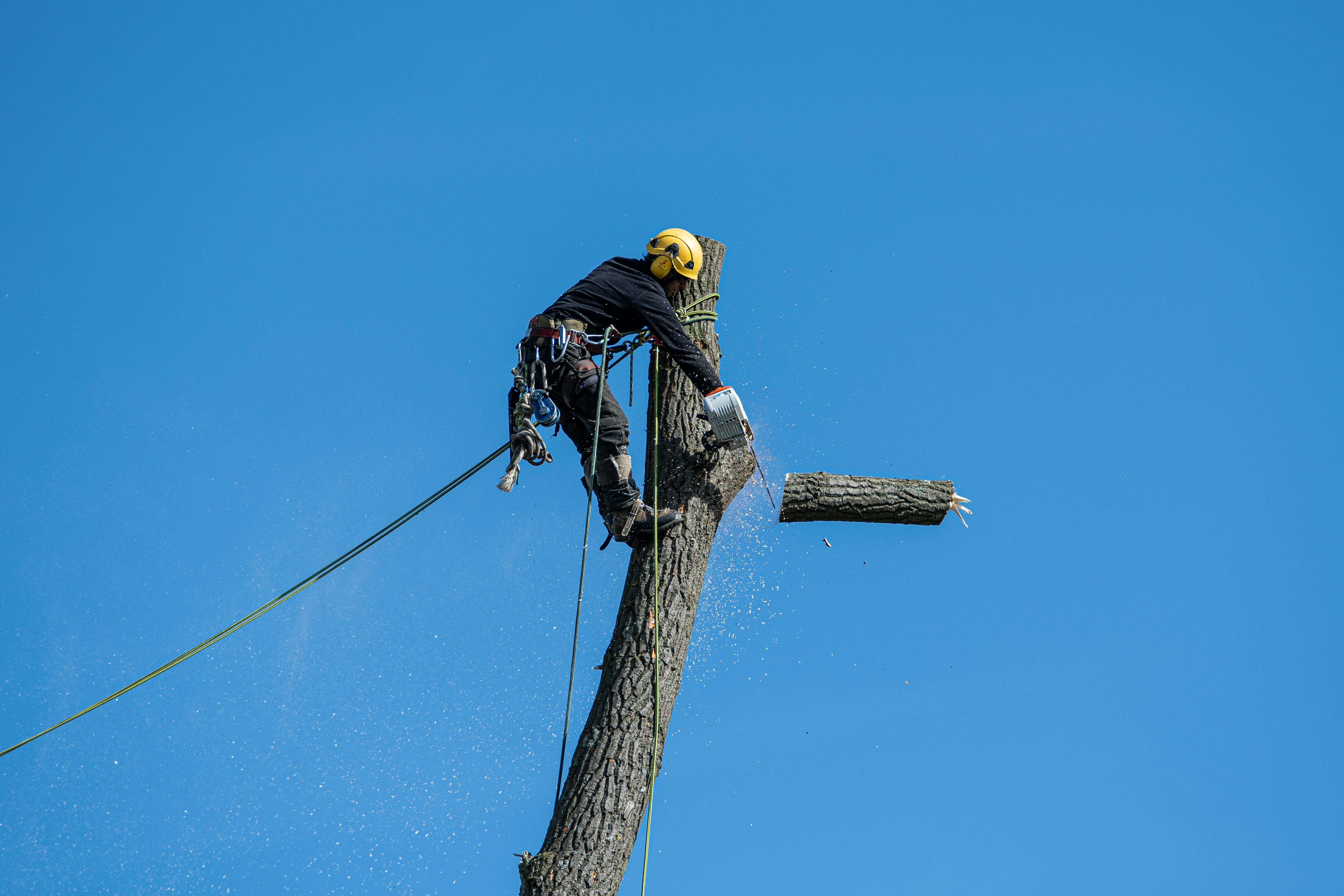
Tree Removal
Removal planning for dead, declining, storm-damaged, crowded, or poorly placed trees around homes, driveways, fences, businesses, and other property improvements.
Learn about tree removal →Tree removal, trimming and pruning, stump grinding, emergency response, commercial tree work, cabling and bracing, and help with tree-health concerns across South Fulton and nearby South Metro Atlanta communities.
Tree service is not one interchangeable task. Removal, pruning, stump work, emergency hazards, commercial operations, support systems, and tree-health concerns involve different questions, methods, and pricing.
Removal planning for dead, declining, storm-damaged, crowded, or poorly placed trees around homes, driveways, fences, businesses, and other property improvements.
Learn about tree removal →
Purposeful pruning for clearance, structure, storm-damaged limbs, deadwood, canopy management, and long-term tree care on residential and commercial properties.
Learn about tree trimming & pruning →
Stump reduction after tree removal for lawns, planting areas, fence lines, landscaping changes, trip-hazard reduction, and cleaner use of the property.
Learn about stump grinding →
Rapid intake for fallen trees, hanging limbs, storm damage, blocked access, trees on structures, sudden leaning, and other urgent tree hazards.
Learn about emergency tree service →
Tree work for offices, retail sites, multifamily communities, churches, industrial properties, institutions, HOAs, and managed properties.
Learn about commercial tree service →
Supplemental support assessment for selected weak unions, co-dominant stems, heavy limbs, and mature trees where support may be one part of a broader risk-management plan.
Learn about tree cabling & bracing →
Assessment-oriented help for declining canopies, leaf discoloration, dead limbs, decay, mushrooms, root stress, pests, construction injury, and other signs that a tree is changing.
Learn about tree health & disease care →South Fulton is not a single uniform suburb. The city stretches across more than 85 square miles and includes everything from developed corridors around Old National Highway and Roosevelt Highway to lower-density and rural areas farther south and west. A contractor may move from a tree squeezed between a house and privacy fence to a larger property where the challenge is a long equipment route, soft ground, drainage, or the volume of debris that must be moved.
That variety is why this site does not treat location as decorative wording. Lot size, access, nearby structures, road exposure, and property use affect the safest practical way to remove or prune a tree. They also affect price. A mature tree in an open field and a similar tree leaning over a roof can require completely different labor, equipment, rigging, and cleanup even when the trunks measure about the same size.
Local soil matters too. University of Georgia guidance notes that in clay soils a large share of tree roots can occupy the upper 12 to 18 inches. Grading, trenching, driveway construction, soil compaction, drainage changes, and repeated vehicle traffic can therefore affect roots without leaving an obvious injury on the trunk. When a tree begins declining after construction or a site change, that history belongs in the assessment.
Weather is another practical factor. Nearby Atlanta climate normals show more than 50 inches of annual precipitation, and Georgia storms can combine wind with saturated ground. UGA storm guidance notes that wet soil can contribute to root failure and uprooting. Newly leaning trees, lifted soil around the root plate, broken major limbs, or sudden changes after a storm deserve prompt attention, but they still need evaluation before assuming the answer is automatic removal.
Root zones: clay and site disturbance can make construction history important.
Storms: saturated ground plus wind can expose root and structural weaknesses.
Access: narrow side yards, fences, long drives, slopes, and soft ground change equipment options.
Targets: roofs, vehicles, roads, utilities, neighboring property, and pedestrian areas change urgency and methods.
Rules: tree-preservation requirements can be especially important when removal is connected to development or land disturbance.
Published Atlanta-area market data gives homeowners a useful starting point, but the estimate for a specific property still depends on access, risk, equipment, debris, and the exact service.
Broad Atlanta-area planning range for many removals. Very large, difficult, or emergency jobs can exceed it.
Common market range, with canopy size, climbing or lift access, branch size, and objectives driving the total.
Common Atlanta-area range. Diameter, root flare, number of stumps, gate access, and chip cleanup matter.
These are general planning ranges from current Atlanta-area pricing sources, not fixed rates or a quote from South Fulton Tree Service. Site conditions determine actual pricing.
After a storm, the most dramatic damage gets attention first, but less visible changes can matter too. Fresh leaning, root-plate movement, a new trunk crack, a split union, hanging broken wood, or a major limb that failed from an otherwise standing tree can all justify faster assessment. If a tree or limb is touching electrical conductors, stay away and contact the appropriate utility or emergency service. Do not attempt to cut or move material around energized lines.
Emergency tree service is about controlling the immediate hazard. Final hauling, stump grinding, restoration, or non-urgent pruning may be scheduled separately when conditions are widespread or access is limited. The intake process should make that distinction clear so a property owner knows what the first visit is expected to accomplish.
Emergency tree service guideSome calls start with decline. Others start with a weak union, heavy limb, construction damage, or a tree that simply needs better clearance. The right service depends on the cause and the consequence.
Thin canopy, discolored leaves, dead limbs, mushrooms, root stress, construction damage, pests, and other symptoms need assessment rather than a confident phone diagnosis. Oak wilt is rare in Georgia, so oak decline should not be automatically labeled as oak wilt.
Explore tree health →Selected weak unions or heavy stems may be candidates for supplemental support, often alongside pruning and ongoing inspection. Hardware is not a guarantee and is not appropriate for every defect.
Explore support systems →Selective pruning can address deadwood, clearance, storm damage, young-tree structure, or particular branch defects without treating every canopy as a candidate for aggressive reduction.
Explore pruning →The primary market is the City of South Fulton. Supporting pages cover nearby communities that make geographic sense for a South Fulton tree contractor, including Union City, East Point, College Park, Fairburn, Douglasville, Riverdale, Tyrone, Palmetto, Hapeville, Chattahoochee Hills, Fayetteville, Peachtree City, and the southwest quadrant of Atlanta.
The Southwest Atlanta page is deliberately narrow. It focuses on areas such as Ben Hill, Greenbriar, Campbellton Road, Adams Park, Midwest Cascade, Cascade Road and Cascade Heights, Venetian Hills, Oakland City, and Fort McPherson. It is not written as a generic claim to serve every neighborhood in the much larger City of Atlanta.
Explore service areasTell us the service, number of trees or stumps, approximate size, condition, city and ZIP code, access, nearby structures, and urgency.
The contractor reviews the property-specific details, determines what needs an on-site look, and confirms whether the request fits the service area.
The quote should reflect the real tree, equipment, access, cleanup, and work method rather than a generic online price range.
Removal, trimming, stump work, storm damage, a hanging limb, decline, visible decay, a weak union, commercial maintenance, or something else.
House, fence, driveway, pool, road, parked vehicles, neighboring property, utilities, sidewalks, buildings, or other targets.
Open front yard, narrow gate, long driveway, steep slope, soft lawn, retaining wall, backyard access, shared driveway, or restricted commercial site.
Atlanta-area data places many tree removals roughly between $200 and $2,000+, but large, hazardous, tight-access, crane-assisted, or emergency jobs can cost more. Tree size is only one factor. Access, nearby structures, rigging, condition, hauling, stump work, and urgency all change the estimate.
It depends on the property and project. South Fulton's tree-preservation ordinance is especially relevant to development, building construction, and timber-harvest activity. Because rules can change and project context matters, confirm current requirements with the city when permitting may apply.
Stay away from the tree, line, and anything the line may be touching. Do not approach, cut, drag, or move material near energized conductors. Contact the appropriate utility or emergency service before tree cleanup proceeds.
Sometimes a structurally valuable tree with a specific weak union may be a candidate for supplemental support, often with pruning and future inspection. Cabling does not make every tree safe and cannot correct severe decay, root failure, or every structural defect.
No reliable service should promise that. Observations are useful, but symptoms can have multiple causes. Site history, soil and root conditions, trunk structure, canopy pattern, and sometimes diagnostic testing are needed before recommending treatment.
The practical South Metro coverage includes Union City, East Point, College Park, Fairburn, Douglasville, Riverdale, Tyrone, Palmetto, Hapeville, Chattahoochee Hills, Fayetteville, Peachtree City, and specific southwest Atlanta neighborhoods. Properties outside those areas can still be submitted for coverage confirmation.
Do not assume it is. Stump grinding should appear as a clear line item or part of the written scope because depth, surface roots, access, chip removal, and restoration expectations affect the work.
Dormant-season pruning is useful for many structural objectives, but species, flowering habits, condition, and the reason for pruning can change the best timing. Storm hazards and deadwood may need attention regardless of season.
No. Some trees naturally lean. A new or increasing lean, especially with soil lifting, root movement, trunk cracking, or recent storm damage, deserves prompt assessment because it can signal a change in stability.
Yes. Larger sites can separate immediate hazards from routine pruning, removals, stump work, and lower-priority items so operations and budget can be managed more logically.
Call (470) 220-4422 or send the project details online. Include the city, ZIP code, service needed, access notes, and anything urgent or unusual about the tree.


