Find the cause before treating the symptoms
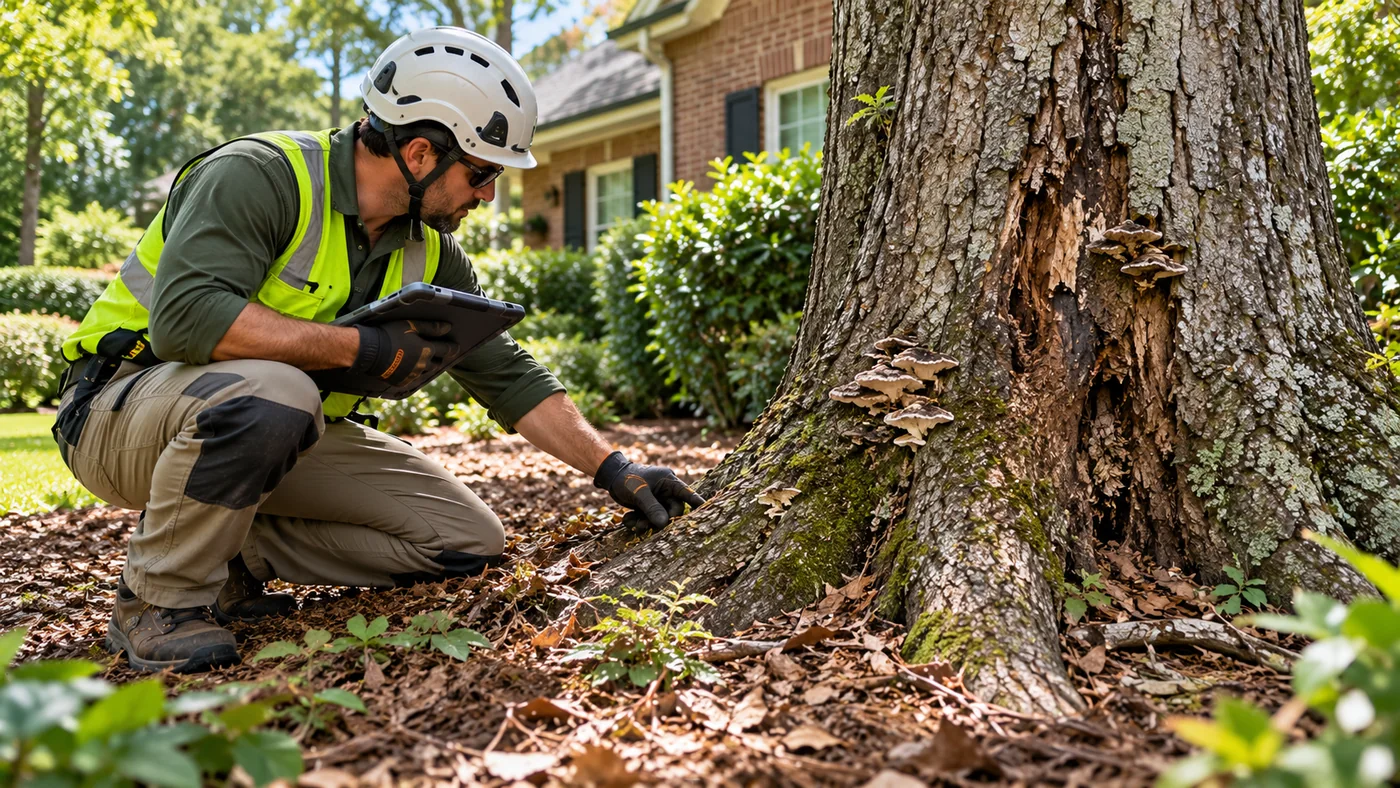
A declining tree can show the same visible symptom for very different reasons. Thin foliage may reflect root damage, drought stress, excess moisture, construction disturbance, disease, insects, poor planting depth, or normal seasonal behavior. Mushrooms may indicate decay in some situations but not every fungus on bark means the tree must be removed. That is why the safest starting point is observation and inspection rather than a confident diagnosis over the phone.
Useful clues include when symptoms started, whether decline is sudden or gradual, which side of the crown is affected, whether nearby trees show similar symptoms, and whether the property recently experienced trenching, paving, grading, irrigation changes, flooding, or storm damage. Photos can help document changes, but root flare, trunk condition, soil moisture, canopy pattern, and site history often need to be considered together.
What a tree-health assessment looks for
The first goal is to identify the likely stress category before recommending treatment. Dead branches may need pruning regardless of the original cause. A root problem may make foliar treatment irrelevant. A tree with advanced structural decay may need risk-focused management rather than a disease spray. When a specific pathogen or insect cannot be identified visually, laboratory or specialist diagnosis may be appropriate before spending money on repeated treatments.
Property owners should also separate 'tree health' from 'tree risk.' A tree can be biologically healthy but structurally weak, and a declining tree can sometimes stand in a low-target area without creating an immediate hazard. The contractor should consider both. If the concern is a limb over a house, sudden lean, root plate movement, major cavity, or other potential structural failure, make that clear when requesting service.
South Fulton soil, drainage, weather, and construction can all affect tree health
UGA identifies root rot as one of the most damaging groups of landscape-tree diseases in Georgia and notes that wet, poorly drained soil can predispose trees to root problems. That is relevant on clay-heavy sites where drainage can be slow. Chronic wetness near downspouts, grading that directs water toward the trunk, or recent soil changes are all worth mentioning when a tree declines.
Oak problems deserve careful language in Georgia. Oak wilt gets attention online, but UGA notes that oak wilt is rare in Georgia and has not been positively identified by its Plant Disease Clinic. South Fulton oak decline should not be automatically labeled as oak wilt. Leaf spots, cankers, root disease, construction injury, drought or drainage stress, insects, and structural issues all have to remain in the differential until the tree is properly evaluated.
What affects the cost of tree health care
Health-related work varies from inspection and pruning to soil, pest, or disease management. The cause has to be identified before a sensible treatment work can be priced. These figures are broad market planning guidance, not a quote or a fixed company rate. See the full South Fulton tree service cost guide for more context. The actual estimate depends on the tree, property, access, equipment, cleanup, and the exact work requested.
- Number and size of trees
- Type and severity of symptoms
- Need for diagnostic testing
- Pruning or deadwood work
- Access to root zone and canopy
- Treatment material and repeat applications if justified
- Structural risk discovered during assessment
Two projects with similar-looking trees can price very differently when one has open truck access and the other sits behind a house with a narrow gate, fence, overhead utilities, soft ground, or a roof beneath the canopy. When comparing estimates, focus on whether each proposal includes the same work: debris hauling, stump work, rigging, restoration, traffic control, and any return visit should be clear rather than assumed.
Treat the cause, not just the symptom
Yellow leaves, canopy thinning, premature leaf drop, dead twigs, and slow growth are symptoms, not diagnoses. Fertilizer, fungicide, insecticide, extra irrigation, and pruning all have legitimate uses in some situations, but applying them without understanding the cause can waste money or add stress. For example, more irrigation is not helpful when roots are already suffering in saturated soil. A health-care recommendation should connect the observed pattern to a plausible cause and explain what change or treatment is expected to improve. When uncertainty remains, monitoring or diagnostic testing can be more responsible than guessing.
Roots and soil matter as much as the canopy
Homeowners naturally look up at leaves and branches, but roots and soil often tell the more important story. Changes in grade, vehicles parked over roots, trenching for utilities, new patios, compacted construction traffic, mulch piled against the trunk, chronic drainage problems, or removal of nearby trees can all affect how a tree performs. The root zone extends well beyond the trunk, so damage does not have to occur at the base to matter. A good site history can shorten the diagnostic process by connecting decline with a change that happened months or years earlier.
What to tell us about the tree
You do not need technical tree vocabulary. Tell us what you see and what you want the property to be like when the work is finished. Useful details include the number of trees or stumps, approximate size, whether branches or the trunk have already failed, what is nearby, whether trucks can reach the work area, and whether the concern feels urgent. The city and ZIP code help confirm travel and service coverage. If the condition involves a recent storm, construction work, new leaning, mushrooms, unusual leaf change, or repeated limb drop, mention that history too.
Photos from a safe location can be useful for context, but the final work may still need an on-site look. Do not climb, walk under hanging limbs, or approach electrical lines to take pictures. The goal is to give the contractor enough context to plan the next step without asking you to diagnose or measure a hazardous tree yourself.